
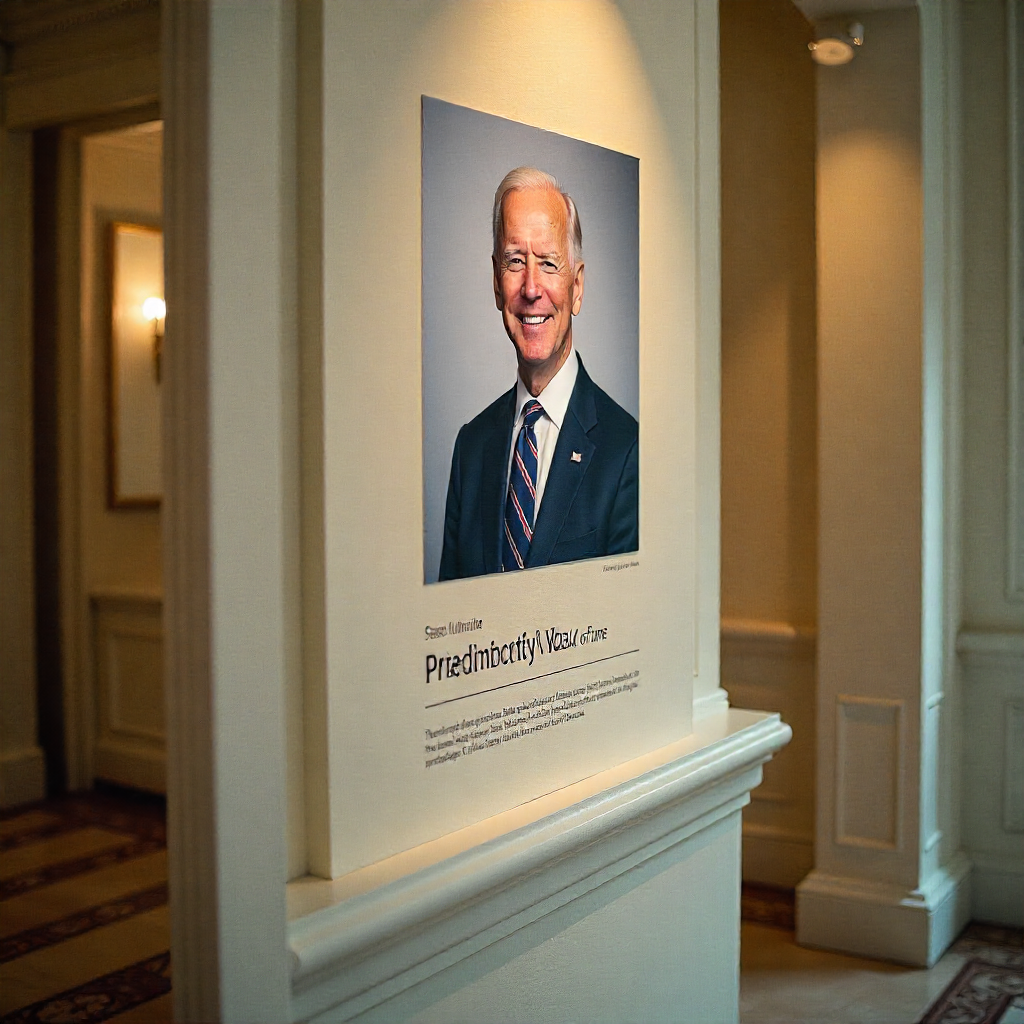
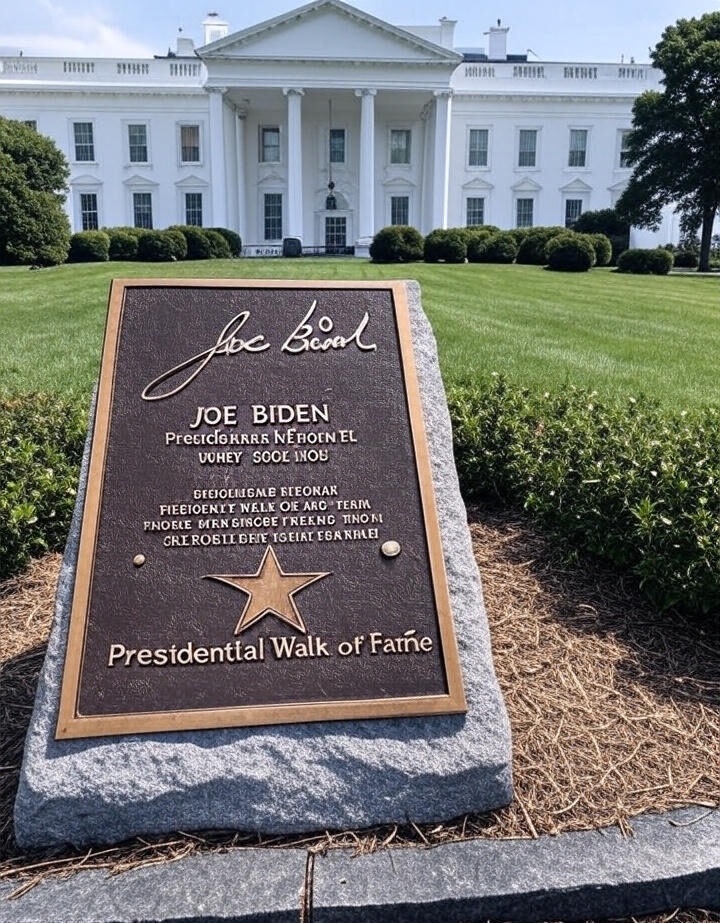
The Trump White House unveiled a new installation dubbed the “Presidential Walk of Fame” along the West Wing colonnade, featuring portraits of all former U.S. presidents. But one conspicuous exception broke tradition: instead of a photo of President Joe Biden, the display includes a picture of an autopen the mechanical signature device signing Biden’s name. (Reuters)
This symbolic snub is the latest move in a broader campaign by Trump and his administration to cast doubt on Biden’s legitimacy and mental acuity, especially by highlighting the latter’s use of autopen during his presidency. Below is a deeper look into what this means, how it fits into U.S. political norms, and the reactions it has ignite
What Happened: The Walk of Fame and the Autopen Portrait
- The Presidential Walk of Fame is a newly installed gallery outside the White House showing framed black and white portraits of past presidents in chronological order. (The Washington Post)
- Trump opted not to include an actual photo of Biden. Instead, the frame reserved for him contains an image of an autopen replicating Biden’s signature a move clearly meant as a visual taunt. (Reuters)
- White House officials confirmed the choice was Trump’s idea. The installation aligns with broader aesthetic changes the administration has already made to White House décor and grounds. (Reuters)
- Trump and his allies have repeatedly seized on Biden’s use of the autopen, alleging without evidence that key decisions, pardons, and documents were signed without Biden’s direct involvement. (AP News)
- Biden and his staff have denied these claims, asserting that whenever autopen was used, it was done with his authorization or in routine circumstances. (ABC News)
Historical & Legal Context: Autopen Use in U.S. Presidencies
To understand the weight of this display, it helps to grasp the role of the autopen in U.S. presidential practice:
- An autopen is a device that mechanically reproduces a signature using real ink. It is commonly used for high-volume or ceremonial signatures when the signatory is unavailable. (Wikipedia)
- Its use by presidents is not new or unusual: past presidents have used it for non controversial documents, proclamations, or letters when unavailable. (Wikipedia)
- In 2005, the DOJ’s Office of Legal Counsel opined that a president may direct that his signature be affixed via mechanical means, and such signing is legally valid.(Globedge)
- Even so, the controversy here is not over autopen itself but over how Trump is weaponizing it symbolically to suggest Biden lacked capacity or control.
- Trump himself has acknowledged using the autopen for routine work, even while challenging Biden’s use of it. (Wikipedia)
- Meanwhile, Republican-led House investigations have zeroed in on Biden’s health, mental acuity, and use of the autopen suggesting that the autopen narrative is now a political tool, not just a procedural question. (Reuters)
Interpretation & Symbolism
This move carries layers of symbolic meaning:
- Delegitimization & Ridicule
Replacing Biden’s portrait with an autopen image is a visual insult. It implies that Biden is too weak, incapable, or not fully present to deserve a real portrait a public gesture of delegitimization. - Narrative of Incompetence
Trump has repeatedly framed Biden as cognitively diminished or controlled by staff. Using the autopen as his “portrait” reinforces that narrative in the White House’s very walls. (AP News) - Rewriting Traditions & Authority
The White House is a highly symbolic space. Altering how presidents are honored is not just decorative it suggests rewriting institutional norms to reflect the current occupant’s views of precedent and power. - Political Theater
The move is as much performance as policy. It’s designed to provoke reaction, dominate media narratives, and deepen partisan identities. - Undercutting Legacies
By visually diminishing Biden’s place among presidents, the current administration aims to erode public memory and historical standing.
Reactions & Critiques
Responses have spanned skepticism, criticism, and concern:
- Journalists and commentators view it as a stunt rather than substantive governance. Many call it a calculated insult rather than a legitimate renaming or tribute. (Reuters)
- Critics argue it lowers institutional dignity, turning presidential commemoration into partisan spectacle.
- Some observers note the irony and hypocrisy: autopen use is broadly accepted historically, and Trump himself has used it; yet he weaponizes it when used by his predecessor. (Wikipedia)
- Biden’s team has so far declined extensive comment on this particular installation, which may reflect a choice to avoid elevating the spectacle. (Reuters)
- The broader public may see this as further evidence of deep polarization and the blending of governance with aggressive political posturing.
Broader Implications
- Erosion of norms: Presidential transitions historically maintain decorum and respect for office, even across party lines. Moves like this challenge those norms.
- Institutional trust: If the White House itself becomes a stage for partisan jabs, public trust in institutional continuity may erode.
- Historical memory: Physical symbols portraits, monuments, galleries shape collective memory. Altering these sends a message about who “deserves” legacy.
- Political escalation: This is part of a broader pattern of symbolic warfare removing portraits, redesigning gardens, rearranging décor where physical space becomes battleground.
- Media & messaging control: In an age of constant media cycles, visual stunts like this command attention and frame narratives immediately.
Conclusion
Trump’s decision to place a picture of an autopen instead of Joe Biden’s portrait in the new Presidential Walk of Fame is more than an aesthetic choice. It is a calculated, symbolic act of political messaging: a visual jab, a claim of delegitimacy, and a reinforcement of narratives about Biden’s capacity and legacy. Trump Walk of Fame, Biden autopen portrait, White House controversy, presidential portraits, Trump Biden feud, autopen controversy, US political symbolism. While some may dismiss it as political theater, its implications for how we perceive norms, memory, and authority in the U.S. presidency are significant.