
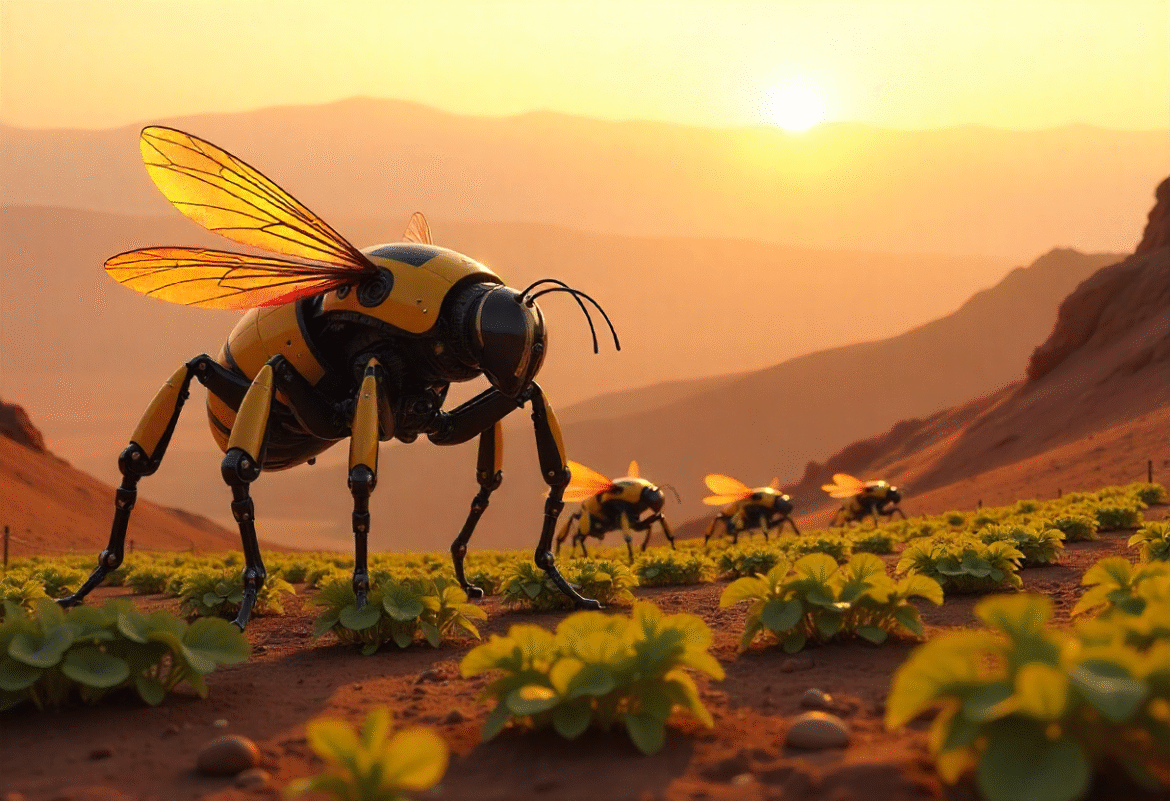
Imagine a swarm of tiny robots each about the size of a bumblebee buzzing across the Martian surface, collecting environmental data or even pollinating plants in future Martian greenhouses. This isn’t science fiction it’s a concept under development known as Marsbees, proposed by NASA’s Institute for Advanced Concepts (NIAC) (AOL, Facebook, YouTube, Environment America, Wikipedia, New Mars).
What Are Marsbees?
Marsbees are bumblebee sized, autonomous flying robots designed to operate efficiently in the thin Martian atmosphere. Each robot is equipped with:
- A stereo color camera, LiDAR, inclinometers, inertial measurement units (IMUs), and communication modules enabling navigation, environmental data capture, and transmission back to a lander or rover (Facebook, YouTube).
- Innovative wing designs inspired by insects, allowing them to passively deform and rotate wings to conserve energy and sustain flight longer than traditional fixed-wing aircraft .
Why Use Robot Bees on Mars?
- Challenges of Martian Flight:
Mars’ atmosphere is only about 1% as dense as Earth’s. Ingenuity the helicopter that flew on Mars overcame this by using ultra fast rotors. Marsbees, being lightweight and designed for minimal lift, use wing deformation and smart aerodynamics for efficient flight . - Autonomous Operation:
With a communication delay of about 15 minutes between Earth and Mars, Marsbees must be autonomous, capable of navigating and responding to environmental changes without real time human oversight . - Swarm Capabilities:
Deployed in swarms, Marsbees could map terrain, sample atmospheric data, and monitor environmental variables. This multi agent system can build 3D topographic maps or measure pressure, temperature, and even mineral composition at scale .
Could Marsbees Pollinate Martian Plants?
In theory, yes but with caveats. Marsbees were originally conceived for exploration and data gathering, not pollination. For actual pollination tasks, plants grown on Mars (in greenhouses or biodomes) would require robots capable of delicate contact transferring pollen without damaging fragile blooms.
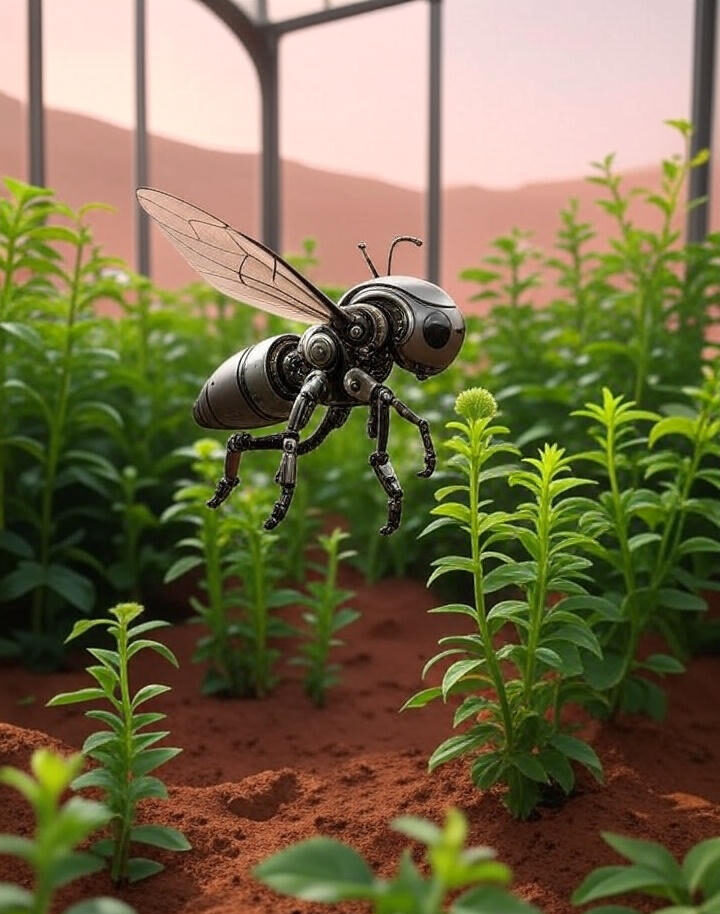
On Earth, pollination robots exist, such as:
- BrambleBee: an autonomous greenhouse robot that uses cameras and robotic arms to gently brush pollen between flowers (arXiv).
- Sticky gel micro drones: drone prototypes coated with pollinating gels that collect and deposit pollen between flowers (Wikipedia, Globedge).
- Precision multi-armed robots (e.g., “Stickbug”) that perform multiple pollinations per minute in structured agricultural environments (arXiv).
Adapting Marsbees for pollination would involve significant redesign adding manipulators, fine sensors, and perhaps sticky substances or brushes. Yet their swarm and autonomous flight capabilities offer a promising foundation.
Future Outlook
Marsbees highlight the potential of swarm aviation in off world environments. While they serve exploration purposes today, their adaptability suggests a future where similar robotic swarms could handle pollination in Martian agriculture should human colonization and greenhouse ecosystems become a reality.
References:
- Marsbees concept details and challenges of Martian flight (Facebook, YouTube, AOL)
- Technical notes on BrambleBee and greenhouse pollination robots (arXiv)
- Sticky-gel drone pollinators research (Wikipedia)
- Stickbug multi-armed pollination robot (arXiv)